
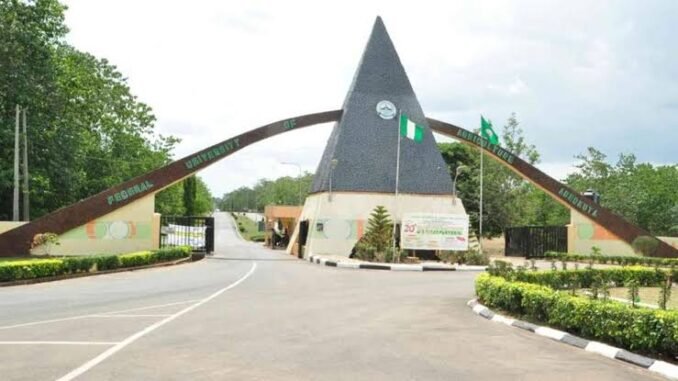
Are you seeking to deepen your expertise in Agricultural Development and Sustainable Environment?
The Federal University of Agriculture, Abeokuta (FUNAAB) is calling for candidates to join their specialised postgraduate programmes for the 2026/2027 academic session.
Introducing CEADESE’s Postgraduate Programmes
The Centre of Excellence in Agricultural Development and Sustainable Environment (CEADESE) at FUNAAB offers advanced training leading to Master’s (M.AgSE) and Doctorate (PhD/PhD.AgSE) degrees, integrating academic and entrepreneurial skills development.
Programmes Offered
- Agricultural Economics and Environmental Policy Programme:
- M.Sc. (Agricultural Economics and Environmental Policy)
- Ph.D. (Options: Production Economics, Resource and Environmental Economics, Agricultural Policy and Development, Agricultural Finance and Marketing)
- Agricultural Mechanization and Sustainable Environment Programme:
- M.AgSE (Agricultural Mechanization and Sustainable Environment)
- Ph.D.AgSE (Option: Agricultural Mechanization and Sustainable Environment)
- Crop/Pasture Production and Sustainable Environment Programme:
- M.AgSE (Crop/Pasture Production and Sustainable Environment)
- Ph.D.AgSE (Options: Crop Production, Plant Breeding, Seed Technology, Crop Pathology, Crop Protection, Crop Entomology, Pasture Agronomy and Pasture Production)
- Environmental Systems and Climate Change Programme:
- M.Sc. (Environmental Systems and Climate Change)
- Ph.D. (Options: Hydrology and Climate Change, Environmental Geophysics, Remote Sensing and Climate Change, Environmental Safety)
- Food Processing and Value Addition Programme:
- M.Sc. (Food Processing and Value Addition)
- Ph.D. (Option: Food Processing and Value Addition)
- Livestock Science and Sustainable Environment Programme:
- M.AgSE (Livestock Science and Sustainable Environment)
- Ph.D.AgSE (Options: Animal Nutrition, Animal Breeding and Biotechnology, Animal Physiology, Livestock Production System)
Why Choose FUNAAB CEADESE Postgraduate Programmes in 2026/2027?
Choosing the Federal University of Agriculture, Abeokuta (FUNAAB) CEADESE postgraduate programmes is a strategic decision for students who want to build a strong career in modern agriculture, environmental sustainability, and agribusiness innovation. The programmes are designed to produce highly skilled professionals through a blend of research, practical training, and industry-focused learning.
1. Specialized and Industry-Relevant Programmes
CEADESE offers focused postgraduate options such as:
- Agricultural Economics and Environmental Policy
- Livestock Science and Sustainable Environment
- Crop and Pasture Production
- Food Processing and Value Addition
- Environmental Systems and Climate Change
- Agricultural Mechanization and Sustainable Environment
These programmes are tailored to solve real agricultural and environmental challenges through applied research.
2. Strong Focus on Research and Innovation
FUNAAB CEADESE emphasizes demand-driven and problem-solving research. Students are trained to develop solutions in:
- Climate change adaptation
- Food security and processing
- Sustainable livestock and crop production
- Environmental protection systems
This makes graduates highly valuable in both academic and industry settings.
3. Entrepreneurship and Agribusiness Development
Unlike traditional postgraduate programmes, CEADESE integrates entrepreneurial training to help students become job creators rather than job seekers.
Graduates are equipped to:
- Start agribusiness ventures
- Innovate in food processing and value chains
- Develop sustainable farming systems
4. Internship and Practical Exposure
Students undergo structured internships and fieldwork training, which help them gain real-world experience in:
- Agricultural industries
- Research institutes
- Environmental and climate projects
This practical exposure improves employability after graduation.
5. International Recognition and Collaboration
CEADESE operates as a World Bank Africa Centre of Excellence, attracting students from across Africa and promoting international research collaboration. This enhances:
- Academic quality
- Research funding opportunities
- Global networking exposure
6. Career-Driven Curriculum
The programmes are designed to prepare graduates for careers in:
- Universities and research institutions
- Government agricultural agencies
- NGOs and international organizations
- Agribusiness and environmental consultancy
7. Contribution to Food Security and Sustainability
Students are trained to address Africa’s major challenges such as:
- Low agricultural productivity
- Climate change impacts
- Environmental degradation
This makes the programme highly relevant to Nigeria and the wider African agricultural sector.
Eligibility Criteria & Duration
Eligibility:
- Candidates of any nationality, from within or outside Africa, who possess qualifications equivalent to recognised first degrees in relevant disciplines, are eligible to apply.
Admission Requirements:
- The M.Sc./M.AgSE and Ph.D./Ph.D.AgSE programmes are generally open to graduates of Agriculture, Environment, Science, Engineering, and Technology with at least a Second-Class Lower degree. This includes graduates of B.Sc., B.Eng., B.Agric., B.Sc. Agric., B.Tech. Agric., B.Eng. Agric., and M.Sc./M.AgSE.
- The basic university matriculation requirements include five ‘O’ level credits, which must encompass English Language, Mathematics, Chemistry, and any two other Science subjects. In the case of Agricultural Economics and Environmental Policy programmes, a background in Agricultural or Social Sciences is also required.
Specific Programme Admission:
- For M.Sc./M.AgSE in Agricultural Economics and Environmental Policy, candidates should have a bachelor’s degree in Agricultural Economics or a related discipline.
- For M.Sc./M.AgSE in Livestock Science and Sustainable Environment, candidates with a bachelor’s degree in animal science or related areas are eligible.
- For M.Sc./M.AgSE in Crop/Pasture Production and Sustainable Environment, the programme is open to those with a bachelor’s degree in agriculture and related disciplines; Food Processing and Value Addition is available to those with degrees in Food Science or related disciplines.
- For M.Sc./M.AgSE in Environmental Systems and Climate Change, candidates should hold a bachelor’s degree in civil engineering, Water Resources and Environmental Engineering, Basic and Applied Sciences, or Environmental Sciences and related areas.
- The Ph.D./Ph.D.AgSE programmes will be open to those holding a relevant master’s degree.
Duration:
- The M.Sc./M.AgSE programme duration is up to 4 Semesters, which includes coursework alongside a dissertation and a 2–3-month internship in collaborating industries, parastatals, and institutions.
- The Ph.D./Ph.D.AgSE programme spans a maximum of 6 semesters, is course and research-based, and also includes a 2–3-month internship. Applications for the Ph.D. are accepted all year round.
Application Process for FUNAAB’s CEADESE
How to Apply
For Applicants from Nigeria:
- Generate an invoice at the Postgraduate application portal of CEADESE-FUNAAB: portal.ceadese.funaab.edu.ng or the new registration version of the site.
- The application fee of NGN 15,000 should be paid at any Zenith Bank branch or via bank transfer. Ensure you get a payment receipt or a teller as proof.
- Upload your proof of payment at portal.ceadese.funaab.edu.ng/upload-receipt and wait for confirmation.
- Once payment is verified, complete your application at portal.ceadese.funaab.edu.ng/login with the details (Account No: 1013968635, Account Name: CEADESE IGR ACCOUNT).
For International Applicants:
- Pay USD 100 into the Centre’s domiciliary account (Standard Chartered Bank’s Account No: 3001180004, SWIFT Code: SCBLUS33, Account Name: CBN FUNAAB TETFUND).
- It’s essential to upload the telex copies to access the online application form as mentioned in point 1.
Transcript Submission:
- All applicants must request their universities to forward their hardcopy transcripts directly to the Director, CEADESE, Federal University of Agriculture, Abeokuta, P.M.B. 2240, Abeokuta, Nigeria.
Deadline:
- The application deadline is Tuesday, 31st March 2026
For further details, applicants can reach out through the following contacts:
- Email: ceadese@funaab.edu.ng
- Website: ceadese.unaab.edu.ng
- Facebook: ceadesefunaab
- Phone: +2348063633341, +2348038155329, +2348038225891
Career Opportunities After Completing FUNAAB Agricultural Postgraduate Studies
Graduating from FUNAAB postgraduate programmes (including CEADESE M.AgSE and PhD AgSE) opens up strong career pathways in agriculture, environment, research, and agribusiness. These programmes are designed to produce professionals with advanced technical knowledge, research skills, and industry-ready agricultural expertise.
1. Academic and Research Careers
Graduates can work in universities, polytechnics, and research institutes as:
- University lecturers
- Research fellows
- Agricultural scientists
- Laboratory and field research officers
These roles focus on solving real agricultural problems through innovation, experimentation, and teaching.
2. Government Agricultural Agencies
Postgraduate holders are highly competitive for roles in government institutions such as:
- Federal Ministry of Agriculture and Rural Development
- State Ministries of Agriculture
- Agricultural Development Projects (ADPs)
- Environmental protection agencies
They may serve as:
- Agricultural extension officers
- Policy analysts
- Environmental and climate change specialists
3. Agribusiness and Private Sector Jobs
The private sector offers strong opportunities in:
- Agro-allied companies
- Food processing industries
- Fertilizer and seed companies
- Farm management firms
Possible job roles include:
- Agribusiness manager
- Production supervisor
- Quality control specialist
- Supply chain and farm operations consultant
4. Environmental and Climate Change Careers
Because FUNAAB CEADESE focuses on sustainable environment and climate-smart agriculture, graduates can work in:
- Climate change projects (NGOs and international bodies)
- Environmental consultancy firms
- Sustainability and natural resource management agencies
Roles include:
- Environmental consultant
- Climate adaptation officer
- Sustainability analyst
5. Entrepreneurship and Agripreneurship
Many graduates also become self-employed by starting:
- Commercial farms (crop or livestock production)
- Agro-processing businesses (food packaging, value addition)
- Fish farming or aquaculture ventures
- Agricultural consulting firms
This path is strongly encouraged due to Nigeria’s growing food demand.
6. International Organisations and NGOs
Graduates may also work with:
- FAO (Food and Agriculture Organization)
- World Bank projects
- USAID agricultural programmes
- Local and international NGOs
These roles often focus on food security, rural development, and sustainability projects.
Your Academic Future in Agricultural Excellence
This is an invitation to become part of a prestigious community committed to agricultural innovation and sustainable practices.
At FUNAAB’s CEADESE, you will gain not just a degree but also practical skills and knowledge to make significant impacts in the agricultural sector.
Frequently Asked Questions: FUNAAB: Broaden Your Agricultural Expertise with Specialized Postgraduate Programmes
1. What postgraduate programmes are offered at FUNAAB?
FUNAAB offers a wide range of postgraduate programmes including Postgraduate Diploma (PGD), Master’s (M.Sc.), Master of Philosophy (M.Phil.), and Doctor of Philosophy (Ph.D.) in various agricultural and related disciplines such as Agricultural Economics, Animal Science, Crop Protection, Agronomy, and Food Science.
2. Who can apply for FUNAAB postgraduate programmes?
Applicants must possess a minimum of a bachelor’s degree (usually at least Second Class Lower Division) from FUNAAB or any recognized university. Some programmes may also accept HND holders with relevant professional experience through PGD pathways.
3. What are the key admission requirements?
Typical requirements include:
- A relevant first degree or PGD certificate (for higher programmes)
- NYSC discharge or exemption certificate (for Nigerian applicants)
- Academic transcripts from previous institutions
- O’Level credits including English and Mathematics
4. Does FUNAAB offer specialized agricultural postgraduate courses?
Yes. FUNAAB is well known for its specialized agricultural training.
Courses are designed to enhance expertise in areas like:
- Agribusiness and Farm Management
- Soil Science and Land Management
- Animal Nutrition and Breeding
- Plant Genetics and Biotechnology
5. How long do postgraduate programmes at FUNAAB take?
- PGD: 1–2 years
- Master’s degree: 2 years (on average)
- Ph.D: 3–5 years depending on research progress
6. Can international students apply?
Yes. FUNAAB accepts international students, provided they meet the academic and language requirements and can provide valid documentation.
7. Are there research opportunities available?
Absolutely. FUNAAB emphasizes research-driven agricultural innovation, offering students access to experimental farms, laboratories, and collaborative research projects.
8. How can I apply for FUNAAB postgraduate admission?
Applications are typically done online through the university’s postgraduate portal. Applicants are required to fill out forms, upload documents, and pay the application fee.
Conclusion
The postgraduate programmes at FUNAAB provide a strong platform for advancing agricultural knowledge, research, and innovation. Whether you aim to specialize in agribusiness, crop science, animal production, or agricultural engineering, FUNAAB offers structured academic pathways that combine theory with practical experience.
By enrolling in its postgraduate programmes, students gain the expertise needed to contribute meaningfully to Nigeria’s agricultural development and global food security.

Be the first to comment